When Stretching Never Seems to Work
Few things are as frustrating as a muscle that stays tight no matter how diligently you stretch it. Calves are a classic example. You stretch before a run, you stretch after, you hang your heels off a step, and within a few hours the tightness is back as if you had done nothing.
When stretching gives you only a few minutes of relief, the problem may not live in the muscle fibers you are targeting. It may live in the fascia, the connective tissue web that wraps and links the muscles together.
Fascia can become restricted and lose its glide, and when it does, the muscle underneath feels permanently short. Stretching tugs on it briefly, but the restriction snaps things back. That is the gap myofascial release is designed to close.
How Myofascial Release Is Different
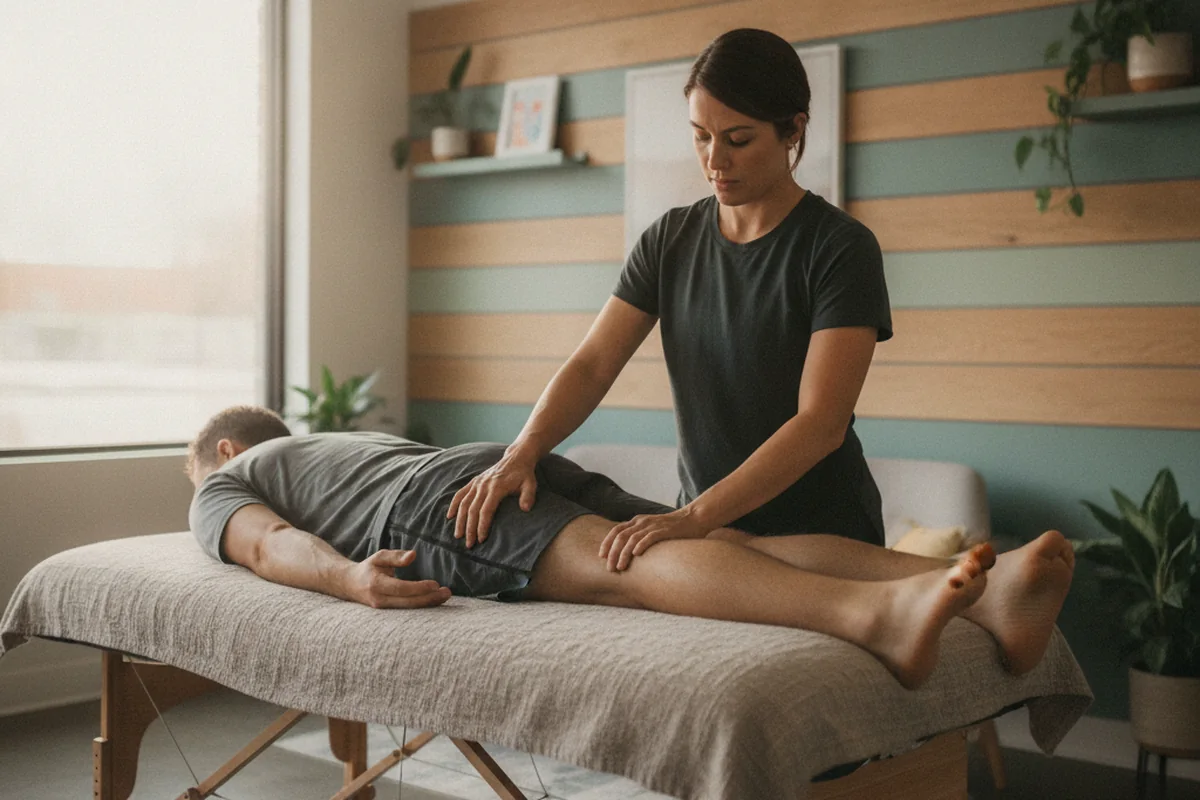
Myofascial release is a sustained, hands-on technique. Instead of a quick push or a brief stretch, the therapist applies gentle, steady pressure into a restricted area and holds it while the tissue slowly lengthens and releases. The timescale is measured in minutes, not seconds.
Our myofascial release therapy follows the John F. Barnes approach, delivered by clinicians trained in the method. The sustained hold is the whole point, because fascia responds to slow, patient loading rather than force.
Restrictions also rarely sit where the ache does. A tight calf can be downstream of something higher in the chain, which is why we assess the whole system rather than only the spot that feels tight. That connected view runs through our entire approach to physical therapy care.
Why Calves Hold So Much Tension
Calves work constantly. Every step, every push off, and every hour spent standing loads them, and in a warm, active region like ours people rack up a lot of miles on foot. Add a job that keeps you upright all day, a new running block, or old scar tissue from an ankle sprain, and the lower leg becomes a magnet for restriction.
Footwear and posture feed into it too. Hours in stiff shoes, a habit of standing with the weight forward, or a stride that overloads one side can all keep the calf and its fascia under constant strain.
Because the cause is often upstream, the fix sometimes involves the ankle, the hip, or the way you load the leg, not just the calf itself. Our clinicians map that out, and you can meet them on our physical therapy team.
What to Expect From Care
A session is unhurried by design, with a full private hour that gives the sustained work the time it needs. Early visits focus on releasing the restricted tissue and finding the real driver of the tightness. As the fascia frees up, we add the loading and mobility work that keeps the gains.
You also leave with self-treatment you own, often a positional hold with a ball at home or a specific way to load the calf so the tightness does not creep back between visits. The aim is to send you off able to manage it yourself.
Your plan is organized through our physical therapy programs, so the goal and the cost are clear from the start. No referral is required to begin under Florida direct access.
Signs the Problem Is Fascial, Not Just Muscular
There are a few clues that point toward fascia rather than a simple short muscle. The first is that stretching gives you only brief relief before the tightness returns, sometimes within the same afternoon. The second is a tightness that feels deep, broad, or hard to pin to one spot, rather than a clean pull in a single muscle.
Another clue is history. An old ankle sprain, a past calf strain, or surgery anywhere down the leg can leave restriction behind that lingers long after the original injury healed. Scar tissue and adhesions do not stretch out the way a tight muscle does, so the usual routine stops working.
If that sounds like your calves, sustained hands-on release is often the piece that has been missing. You can call us at (305) 967-8976 if you want to describe what you have been feeling before you book.
For Runners, the Calf Is a Frequent Culprit
Runners feel calf restriction more than most, because every stride loads the lower leg and the fascia that links it to the foot and the hip. A tight calf rarely stays a local problem. It can change how the foot strikes, nag at the Achilles, and quietly shift stress up to the knee.
That is why we treat the calf as part of a chain rather than an isolated muscle. Freeing the restricted tissue is the first step, but we also look at how you load the leg when you run and whether the hip and foot are doing their jobs. When they are not, the calf keeps picking up the slack.
For runners working back from a nagging issue, this work often pairs naturally with our running rehabilitation, so the tissue release and the return-to-run plan move forward together rather than in isolation.
What a Typical Progression Looks Like
Care usually moves through a few clear stages. Early visits focus on releasing the restricted tissue and finding the real driver of the tightness, whether that sits in the calf itself or higher up the chain. As the fascia frees up, the calf starts to feel looser for longer stretches between sessions.
From there we shift toward loading. A calf that has been tight for months is often weak as well as restricted, and strength is what keeps the release from slipping back. We build that strength gradually, matched to how you actually use the leg.
The final stage is handing it over to you. You leave with a short routine and a clear sense of which early signs mean it is time to do your release work, so a tight calf never gets the chance to derail your training again.
Lasting Calf Relief in Hallandale
Runners, walkers, and people who stand all day across the Hallandale Beach area bring us the same complaint: calves that will not loosen no matter what. When stretching has run its course, sustained myofascial work is often the missing piece.
If your calves have been tight for months and nothing has held, it is worth finding out whether fascial restriction is the reason. A consult will give you that answer and a plan to act on, with no referral needed to start.
Frequently Asked Questions
Why do my calves stay tight even though I stretch them?
If stretching only helps for minutes, the restriction may be in the fascia rather than the muscle fibers. Fascia responds to sustained, hands-on release rather than brief stretching, which is why the tightness keeps returning.
Does myofascial release hurt?
It should not. The technique uses gentle, steady pressure held over minutes while the tissue lengthens. It feels different from a deep, forceful massage, and most people find it calming rather than painful.
How is this different from foam rolling?
Foam rolling is brief and self-applied. Clinical myofascial release uses a trained therapist applying a sustained hold to a specific restriction, often after finding a driver elsewhere in the chain that rolling would miss.
Do I need a referral to be seen?
No. Florida direct access lets you book a consult and start without a physician referral. If care continues beyond 30 days, a physician prescription is needed to continue.