

Physical Therapy Info Health Tips
Our Integrated Physical Therapy blog, your go-to source for physical therapy articles and holistic health information. We provide expert insights, practical physical therapy tips, and the latest developments in the field. Whether you're recovering from an injury, managing chronic pain, or looking to improve your overall well-being, our physical therapy blog covers a variety of helpful topics.
Our goal is to empower you with the information you need to take an active role in your health and recovery. Ready to schedule an appointment and take control of your health? Contact Integrated Physical Therapy at 305-967-8976.
Is the Schroth Method in Hallandale Helpful for Uneven Shoulder Alignment?

Uneven shoulders aren't just aesthetic. They're mechanical. One side elevated, the other dropped—it creates tension, shifts weight distribution, and throws off everything downstream. The spine compensates. The hips follow. And before you know it, you're dealing with neck pain, headaches, or that nagging discomfort between your shoulder blades that won't quit.
Most people assume it's posture. Maybe it is. But more often than not, uneven shoulders trace back to something structural—scoliosis, muscle imbalances, old injuries that never got properly addressed. And if you're in Hallandale looking for answers, the Schroth Method keeps coming up. So here's the question: does it actually work, or is it just another therapy trend that sounds good on paper?
Where Uneven Shoulders Actually Come From
Scoliosis is the big one. When your spine curves sideways, your ribcage rotates, and your shoulders follow that twist. One goes up, one drops back. It's not just about standing straighter—it's about how your entire skeletal frame is aligned. But scoliosis isn't the only culprit. Carrying a bag on the same shoulder every day, favoring one side during workouts, sitting hunched over a desk for years—all of it adds up.
Over time, your body adapts. Muscles on one side get tight. The other side weakens. Your brain stops noticing the asymmetry because it's been there so long. And that's when the real problems start—compensatory pain, limited range of motion, chronic stiffness that physical therapy and stretching can't seem to touch.
The Schroth Method Breaks Down the Problem Differently
Traditional PT looks at shoulders like isolated joints. Stretch this muscle, strengthen that one, maybe throw in some postural cues. The Schroth Method? It sees the whole system. Developed in Germany nearly a century ago, it was built specifically for scoliosis—but the principles apply to anyone whose spine, ribcage, and shoulders aren't tracking symmetrically.
What makes it different is the three-dimensional approach. You're not just pulling your shoulders back or lifting your chest. You're learning to elongate your spine, de-rotate your trunk, and engage specific muscles in a sequence that actually corrects the imbalance. Every exercise is tailored to your curve pattern, your compensations, your body. And that's the part most people miss—generic fixes don't work when the problem is unique.
How It Targets Shoulder Asymmetry
Schroth therapists don't guess. They assess your posture from every angle, map out your spinal curve, and identify exactly which muscles are overactive and which are dormant. Then they build a program around that data. The exercises themselves look strange at first—asymmetric stretches, rotational breathing, positions that feel awkward until your body starts to remember what balanced actually feels like.
Here's what that process involves:
- Corrective exercises designed for your curve type: Every Schroth program is individualized based on your specific spinal pattern and shoulder position.
- Rotational breathing techniques: You're taught to expand the collapsed side of your ribcage, which helps bring the elevated shoulder down and the dropped shoulder up.
- Postural retraining during daily activities: It's not just what you do in the clinic—it's how you sit, stand, and move when no one's watching.
- Muscle activation sequences: You learn to fire muscles in the right order to support alignment, not just mimic it temporarily.
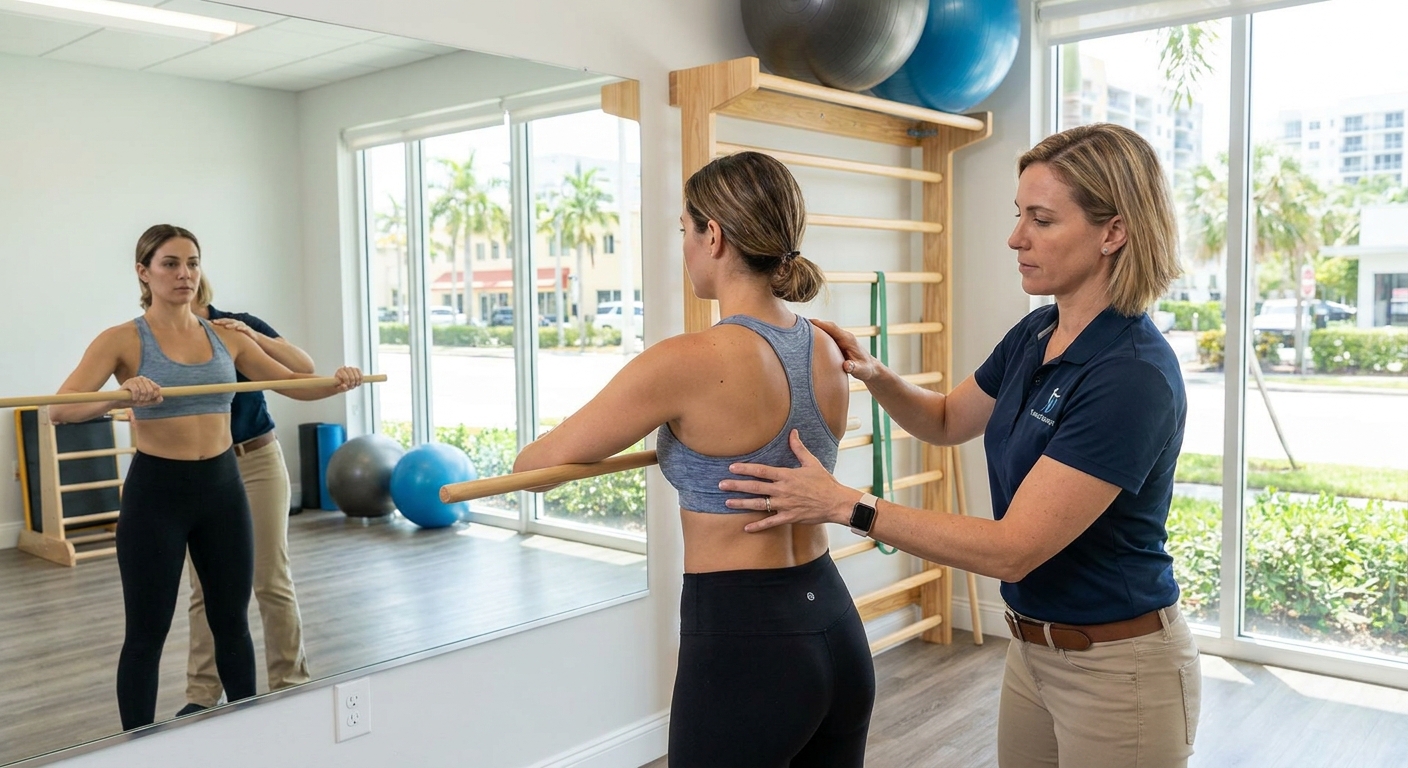
- Mirror and tactile feedback: Therapists use hands-on cues and visual tools so you can feel and see the corrections happening in real time.
What Hallandale Residents Get Access To
Finding a certified Schroth therapist isn't as common as finding a general PT. But in Hallandale, that access exists—and it matters. A certified provider knows how to read your body's specific compensations and won't waste time on cookie-cutter routines that don't address the root cause.
Here's what sets the Schroth approach apart locally:
- Non-invasive and evidence-backed: You're not being pushed toward surgery or bracing unless absolutely necessary.
- Long-term correction, not temporary relief: The goal is to retrain your nervous system and musculature so the changes stick.
- Age and severity don't disqualify you: Whether you're dealing with mild asymmetry or a significant curve, the method scales to meet you where you are.
- Collaborative care options: Many Schroth therapists work alongside orthopedic specialists, chiropractors, and other providers to ensure comprehensive treatment.
- Self-management skills for life: You walk away knowing how to maintain your alignment without needing constant intervention.
When the Method Makes the Most Sense
If you've tried traditional PT and your shoulders still aren't level, that's a signal. If you've been told you have scoliosis but were never given a structured plan to address it, that's another one. And if your daily discomfort is starting to interfere with work, exercise, or just feeling comfortable in your own skin—it's worth the consultation.
The Schroth Method isn't a quick fix. It requires consistency, practice, and a willingness to relearn how your body moves. But for people who commit to the process, the results speak for themselves. Shoulders level out. Pain decreases. Posture improves without constant mental effort. And the relief isn't just physical—it's functional.
What to Expect During Your First Sessions
Your initial evaluation will be thorough. Expect measurements, photos, postural analysis, and a detailed discussion about your history. From there, your therapist will design a program that matches your curve type and compensatory patterns. Early sessions focus on teaching you the exercises and breathing techniques. Later sessions refine your form and adjust the program as your body responds.
Most people notice changes within a few weeks—not just in how their shoulders look, but in how they feel. Less tension. Better balance. More control. And the best part? Once you've learned the system, you can practice it anywhere. No equipment. No gym. Just you and the muscle memory you've built.
Documentation and Consistency Drive Results
Like any corrective program, the Schroth Method only works if you show up. That means doing your exercises at home, applying postural cues throughout the day, and staying engaged with your therapist's feedback. It's not passive treatment—it's active rehabilitation.
Here's what keeps people on track:
- Progress photos and measurements: Visual proof of improvement helps reinforce the work you're putting in.
- Clear exercise protocols: You'll receive written or video instructions so there's no guessing between sessions.
- Regular reassessments: Your program evolves as your alignment improves, ensuring you're always working at the right level.
- Home practice logs: Tracking your consistency helps identify patterns and areas where you might need more support.
- Ongoing therapist communication: Questions don't wait until your next appointment—good Schroth providers stay accessible.
Common Pitfalls People Run Into
The biggest mistake? Expecting overnight results. Your shoulders didn't get uneven in a week, and they won't correct in one either. The second mistake is inconsistency. Doing your exercises sporadically won't retrain your nervous system—it just frustrates the process.
Another issue is trying to DIY the method without proper instruction. Schroth exercises look simple, but the nuances matter. The angle of your pelvis, the rotation of your ribcage, the timing of your breath—all of it has to be precise. Without a trained eye, you can reinforce the wrong patterns instead of correcting them.
When to Bring in a Specialist
If your shoulder asymmetry is mild and you've never been diagnosed with scoliosis, general PT might be enough. But if there's a curve involved, or if traditional approaches haven't moved the needle, a certified Schroth therapist is the next logical step.
Here's when that referral makes sense:
- You have a documented spinal curve: Even mild scoliosis benefits from Schroth-specific intervention.
- Your shoulders are visibly uneven despite months of stretching and strengthening: Generic exercises won't correct three-dimensional misalignment.
- You're experiencing chronic pain or tension on one side: That's often a sign of deeper compensatory patterns.
- You want to avoid or delay surgical intervention: Schroth can stabilize curves and reduce the likelihood of progression.
- You're serious about long-term correction: If you're ready to commit, the method delivers.
Alignment That Holds Up Under Pressure
Uneven shoulders aren't just a mirror problem. They're a mechanical one. And mechanical problems don't fix themselves with better intentions or occasional stretches. The Schroth Method offers a structured, evidence-based path to real correction—if you're willing to put in the work. For Hallandale residents who've been told to just "stand up straighter," this is the alternative that actually addresses what's broken. Many patients benefit from complementary approaches like manual therapy and holistic therapies to support their alignment journey. Not with guesswork. With precision.
Ready to Take the Next Step Toward Better Alignment?
We know how frustrating it can be to deal with uneven shoulders and the discomfort that comes with them. Let’s work together to restore your balance and help you move with confidence again. Give us a call at 305-967-8976 or request an appointment to start your personalized Schroth Method journey with our team.